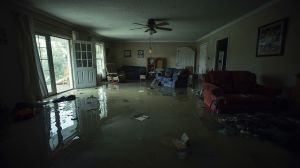
 Lounge wrecked by filthy floodwater
 Flood damaged household items in a skip
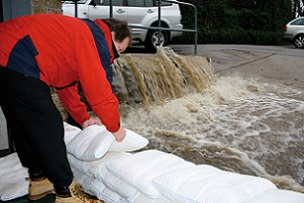 FloodSax alternative sandbags keeping torrential floodwater at bay
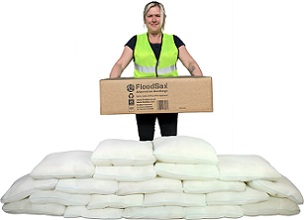 These 20 FloodSax sandless sandbags came from this one easy-to-carry box
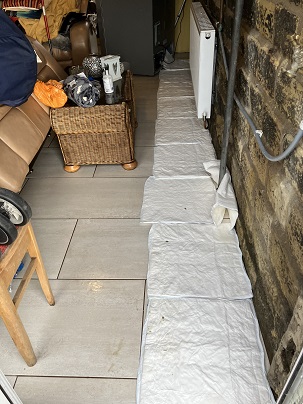 FloodSax in their dry state soaking up water seeping inside a cottage during torrential rain
Why FloodSax prevents tonnes of water damaged items being needlessly thrown away in council tips
When we do FloodSax demonstrations people often ask us how biodegradable and environmentally friendly they are … but to fully understand that we always say they need to look at the bigger picture.
In short, FloodSax prevent an awful lot of other, far larger and environmentally-polluting items going into landfill.
Unlike traditional sandbags, FloodSax alternative sandbags are largely biodegradable by weight.
This is because they are energised by water which the gelling polymer inside the FloodSax absorbs and retains so when FloodSax are thrown into landfill the weight of rubbish tipped on top of it compresses the FloodSax and squeezes the water out which then causes the gelling polymer inside the FloodSax to break down.
The warmer it is inside the refuse dump, the quicker the polymer will break down.
The super absorbent gelling polymer is cellulose pulp which makes up most of the Floodsax and is inherently degradable in natural environments and the wood pulp in FloodSax is made from renewable wood pulp so is also biodegradable.
Traditional sandbags often have polypropylene covers which are not biodegradable and the sand itself is non-biodegradable.
Always look at the bigger environmental picture when it comes to alternative sandbags
When considering how biodegradable FloodSax are it’s important to always look at the bigger picture.
FloodSax have a uniform shape and size so are better to stack as a flood barrier and better than traditional sandbags at keeping water out of homes and businesses, preventing floodwater damage. The more the water is kept out, the better for the environment as less damage is done to fixtures, fittings and furniture.
In their dry state, FloodSax are very flat with a large surface area so can soak up leaks, drips and floods from internal escapes of water – something sandbags can’t do – again preventing a colossal amount of damage.
Water damage takes a lot of natural resources to repair – new carpets, floors, plasterboard, skirting boards, kitchen appliances (the list goes on) – and all the energy that takes to source, manufacture, transport and store.
According to the Association of British Insurers, the average claim for a flooded business is £70,000 while the average cost of a flooding claim on home insurance is around £32,000. That’s an awful lot of damage and cost, both in monetary terms and to the environment, to repair.
Just think of all the water damaged items that would go to landfill – it would fill a large skip. All this could be avoided with FloodSax which would have a miniscule impact in landfill by comparison.
By stopping a flood using FloodSax it would also save all the cost of repairs and the vast amount of raw materials needed to do the full renovation.
This is what we mean by always considering the bigger picture.
Are FloodSax alternative sandbags toxic or hazardous to humans, animals or plants?
The answer is a resounding no.
The main three components in FloodSax are wood pulp, non-woven hydrophylic and super absorbent polymer. All are non-toxic and not harmful to humans or animals.
In some hot countries where water supply is a problem it has been known for used FloodSax to be buried in the ground and then plants, flowers, shrubs and trees to be planted on top as the slow release of water from the FloodSax as it decomposes helps their growth.
How biodegradable are FloodSax sandless sandbags compared to traditional sandbags?
In their dry state almost 35% (just over a third) of a FloodSax is biodegradable which is the wood pulp.
FloodSax are more biodegradable than sandbags as the sand won’t break down, unlike the wood pulp inside the FloodSax.
The water is retained by the cellulose pulp inside which means the water itself makes up the vast majority of the Floodsax. Cellulose is a natural biopolymer extracted from plant cell walls and is inherently degradable in natural environments.
Wood pulp is made from renewable wood pulp so is biodegradable.
The polypropylene tissue used to manufacture the outer non-woven cover for the FloodSax is not biodegradable although it is non-hazardous to the environment.
The superabsorbent polymer in the FloodSax is needed to absorb the water into the pulp and is very slow to biodegrade (taking 20 to 30 years) but only makes up a small proportion of the actual FloodSax.
Sandbags often have polypropylene covers which are not biodegradable, burlap covers which can take a long time to degrade or hessian which decay in contact with water so there is the risk the sand will fall out even while it’s being deployed as a flood barrier, get washed down drains and culverts, causing environmental problems or blocking them and leading to more flooding and more damage inside homes and businesses.
So, when it comes to FloodSax, it’s way more beneficial to the environment to use them than not to use them to keep floodwater at bay.