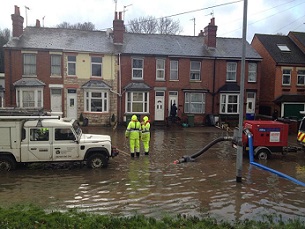
 More and more homes are getting flooded
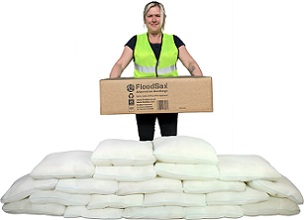 All these 20 FloodSax came from this one easy-to-carry box
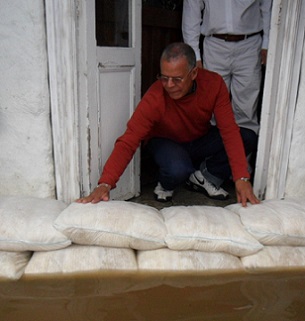 FloodSax keeping filthy floodwater out of a home
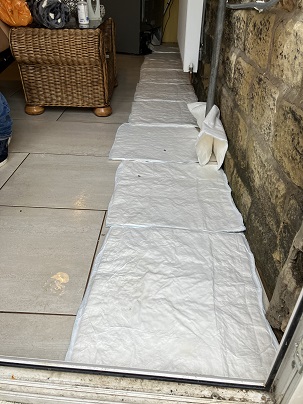 FloodSax soaking up water dripping down a wall inside a cottage
Thousands of homes being built in flood risk areas across the UK every year according to insurance giant Aviva
More and more homes are being built in flood risk areas and the trend is set to not only continue but accelerate.
The warning has come from insurance giant Aviva backed by data from the Environment Agency.
One in nine new homes in England constructed between 2022 and 2024 were in areas of medium or high risk of flooding.
Aviva’s analysis combined with the Environment Agency’s latest assessment of flood risk shows there is a worrying upward trend of new homes being built in high-risk areas in recent years.
The data reveals that out of the 396,602 new homes recorded by the Ordnance Survey in England between 2022 and 2024, 43,937 are in areas of medium or high risk of flooding. Over a quarter (26%), equivalent to 101,657, new homes have some risk of flooding.
Previous analysis from Aviva, based on government statistics, found that 8% of new homes were built in flood risk zones between 2013 and 2022.
The outlook for the future is even more concerning. By 2050, 15%, or one in seven, new homes built between 2022 and 2024 will be at medium or high risk of flooding as the impacts of extreme weather become more acute.
This is despite homes built since 2009 being excluded from the Flood Re reinsurance scheme which was set up in 2016 to improve the affordability and accessibility of flood insurance to properties in high-risk areas.
Jason Storah, CEO UK & Ireland General Insurance at Aviva, said: “We support the Government’s plans to build more homes to help drive economic growth.
“However, this growth needs to be sustainable and it’s vital that new homes are built in the right places and with resilience in mind to help homeowners get ready for future impacts.
“As our analysis shows, too many new homes have been built in higher risk areas. It’s particularly worrying this trend has risen in recent years just as house building accelerates.
“Importantly, these homes are not protected by the Flood Re scheme which excludes homes built after 2009 to prevent more new homes being put at risk. Sadly, as the study shows, this simply hasn’t happened.”
“We believe there should be a presumption against new developments in high-risk areas in the planning rules, alongside mandatory flood resilience measures in building regulations for new homes in areas at risk. This is particularly important in places where surface water flooding is prevalent, which is more difficult to predict and protect against. Property flood resilience does not have to be expensive and effective measures can be installed for under £1,000.’’
A far more cost effective way to protect homes and businesses from flooding is with FloodSax alternative sandbags that cost a mere £140 or less for a box of 20.
FloodSax are vacuum-packed and when unwrapped resemble a large pillowcase but when they are immersed in water they absorb around 20 litres and retain it, transforming them from being as light as a pillowcase to being more effective than traditional sandbags in around five minutes.
In their dry state FloodSax are super-absorbent yet thin with a large surface area so are highly effective at soaking up drips, leaks, spills and floods inside homes and businesses, especially in hard-to-reach places such as beneath pipes, radiators, sinks and boilers. They also soak up floodwater dripping in through leaky roofs and windows.
A new product called a TubeSax is being launched this autumn by FloodSax manufacturers Environmental Defence Systems Ltd designed predominantly to prevent floodwater getting through standard doors.
Aviva’s Building Future Communities report, published in October 2025, found that every constituency in Great Britain is projected to have increased flood risk (river, coastal or surface water) in future. In England alone, 69% of constituencies are projected to see an increase of over 25% in the number of properties facing flood risk by mid-century.
The worst areas for this are Greater London, Essex, Lincolnshire, the north west and western regions. Whilst it may be more difficult to prevent new housing developments in some areas which are naturally more prone to flooding and have less land available for development, it is even more important that these homes are protected by property flood resilience measures.